Climate- Disaster – Pandemic: National Initiatives Strategy A Current Analysis
- Administrator
- Rabu, 22 Juli 2026 07:21
- 322 Lihat
- Rilis Berita
Climate - Disaster - Pandemic:
National Initiatives Strategy
A current analysis
By
Soroy Lardo
Medical Biodefense Research Center (MBRC)
Faculty of Military Medicine, Defense University
To understand Health systems resilience in relation to climate change, disasters, and pandemics, the current presentation covers: Introduction; Health Systems Resilience; Climate Change and Biodiversity Ecology; Disaster and Integrative Perspectives; and Pandemic Architecture.
Climate change as an environmental determinant with long-term impacts on lifestyle, disasters as a long, hard-working process, and COVID-19 as a transboundary disease that permeates various sectors of life.
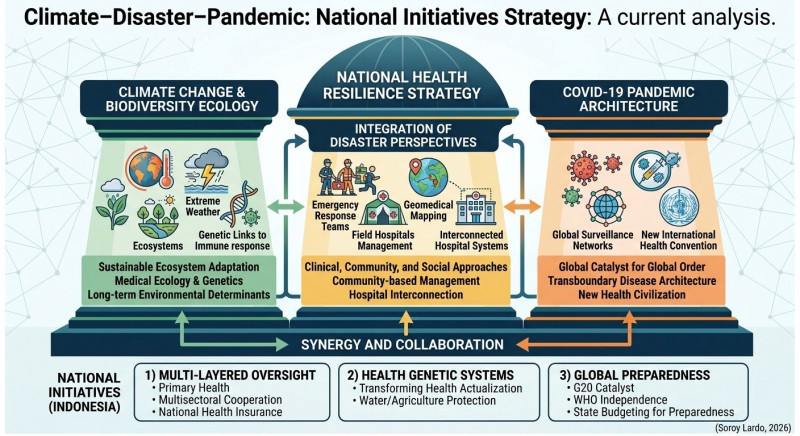
The concept of a health resilience system needs to be underpinned by a multi-layered oversight approach, namely by utilizing primary health services, multi-sectoral cooperation, and empowering the National Health Insurance with the principles of nationality, collaboration, and self-resilience.
The impacts of environmental health and infectious diseases include internal, external, and indirect effects. Internal system impacts affect immune responses to infectious interventions. External system impacts affect global environmental conditions, resulting in asymmetrical relationships and realities, and indirectly drive changes in mosquito vector bionomics that accelerate the breeding cycle.
The health genetic systems approach is a transformation of health actualization and empowerment, developing a stable ecosystem in public health grounded in the core ideas of medical ecology, genetics, immunology, and epidemiology. Developing models for the protection of water, agriculture, and other natural resources. Developing a social epidemiological model to map multifactorial social patterns of health and disease helps uncover social explanations rather than traditional biological explanations.
Disaster Integration needs to be understood through clinical, community, and social approaches that include geomedical maps, outbreak patterns, integration of clinical and community disaster systems, the concept of sociability, community-based management, and, most importantly, the interconnection of hospitals and the role of field hospitals.
Disaster and Outbreak Patterns, in the context of Outbreak Patterns, emphasize the monitoring and evaluation of inherent and prophetic approaches to information communication. Meanwhile, in the context of hospital interconnection, it emphasizes the importance of emergency preparedness, the multisectoral nature of understanding infectious agents, and the community's empowerment of institutional structures and participation.
COVID-19, as a transboundary disease, is a community-spreading disease characterized by asymptomatic cases, mobility and migration, and a clinical spectrum that includes symptomatic variants and organ-system impacts. The initial pandemic stage will transition to an endemic phase. The analysis of COVID-19 determinants from a Health Security perspective comprises Geomedical Information Systems, Human Resources, and Health Efforts. The Geomedical Information System is a form of data integration on health problems in the field by health workers with multifunctional competencies.
Human health resources empower technology products as global spiritual values, sustainability, critical thinking, and responsibility towards the community. Health efforts include medical intelligence and risk health assessment, empowering community health centers and referral hospitals, and strengthening community participation through integrated health posts (Posyandu)
President Joko Widodo stated at the G20 Summit in Italy on October 30, 2021, that the COVID-19 pandemic was a catalyst for a change in the global order (a new global framework) that encouraged global preparedness to face pandemics, based on the IHR and the PHEIC as a new pandemic convention. Each country will invest in preparedness to ensure the availability of medicines, vaccines, medical devices, and skilled human resources, and will commit to state budgeting and global surveillance to prevent the spread of the pandemic.
Strengthening the independence of the WHO in global health restructuring and diplomacy. The New Architecture of Global Health will shape a new civilization of health and national resilience in every country.
Conclusion
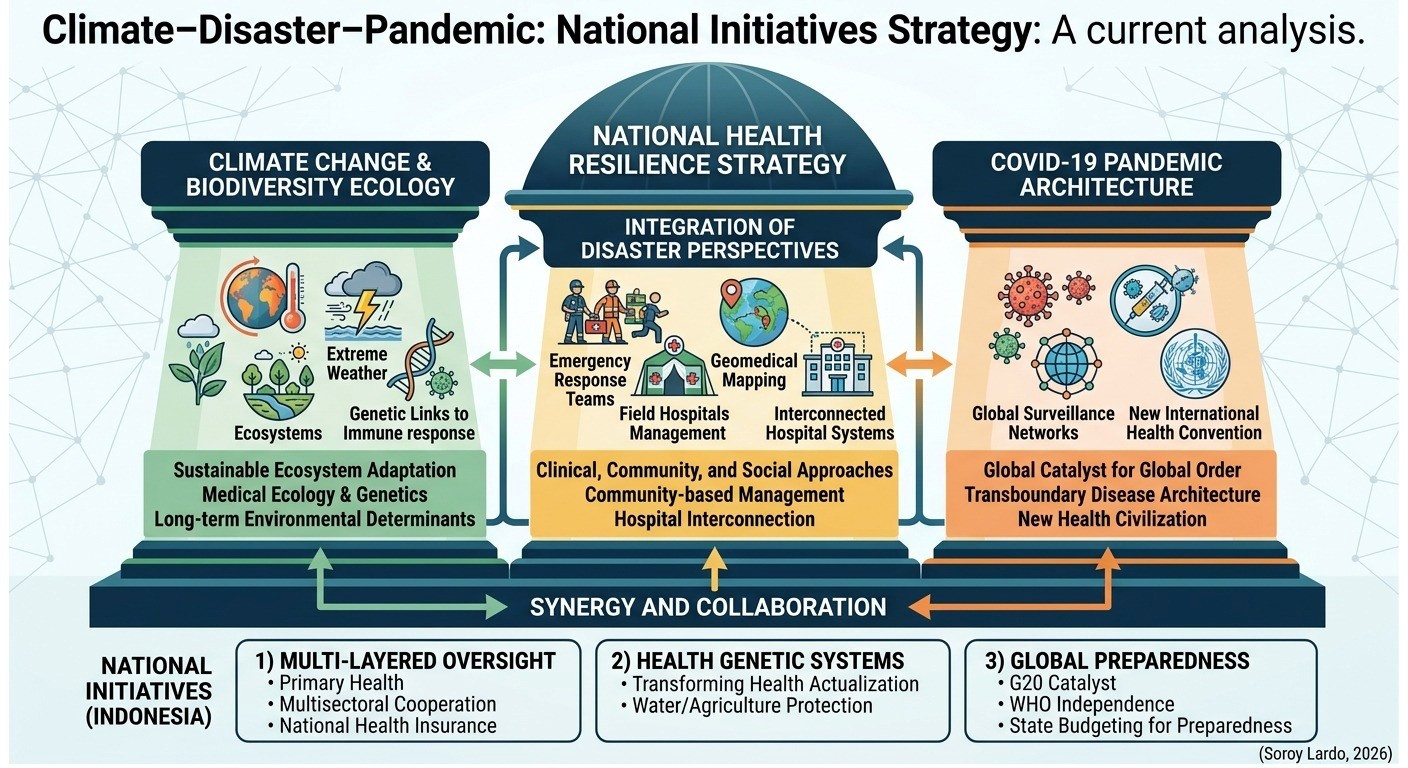
Climate Change and Biodiversity Ecology, Integration of Disaster Perspectives, and COVID-19 Pandemic Architecture are the three main pillars for bridging health strategies and policies grounded in health resilience. A paradigm shift based on synergy and collaboration in defining the environment as a sustainable ecosystem adaptation, as well as the new COVID-19 pandemic architecture as a global catalyst that includes a health civilization in facing the next pandemic.
Climate initiatives and Disaster - Pandemic Infection